The Bank Compared Our Client's VAT Returns With Its Bank Credits. They Didn't Match.
A real case: a bank found VAT returns didn't match bank credits at facility renewal. How we reconciled it, why it led to a voluntary disclosure, and how to check first.
Banks used to look at your audited accounts. Many now also look at your VAT returns, and compare them with the money going into your account.
This is a case from my practice, with the client’s details left out.
What happened
A client applied to renew a bank facility. As part of its review, the bank compared the sales in the client’s VAT returns with the credits in its bank statements. The two didn’t match, and the bank asked for an explanation before it would go ahead.
How we resolved it
We reconciled the bank credits to the sales in the returns. Most of the gap had ordinary explanations: money coming in that wasn’t sales, and timing.
After those, a balance was left that was sales which hadn’t been reported in the VAT returns. The client filed a voluntary disclosure to correct the returns, and the reconciliation went back to the bank with the explanation.
What the reconciliation looks like
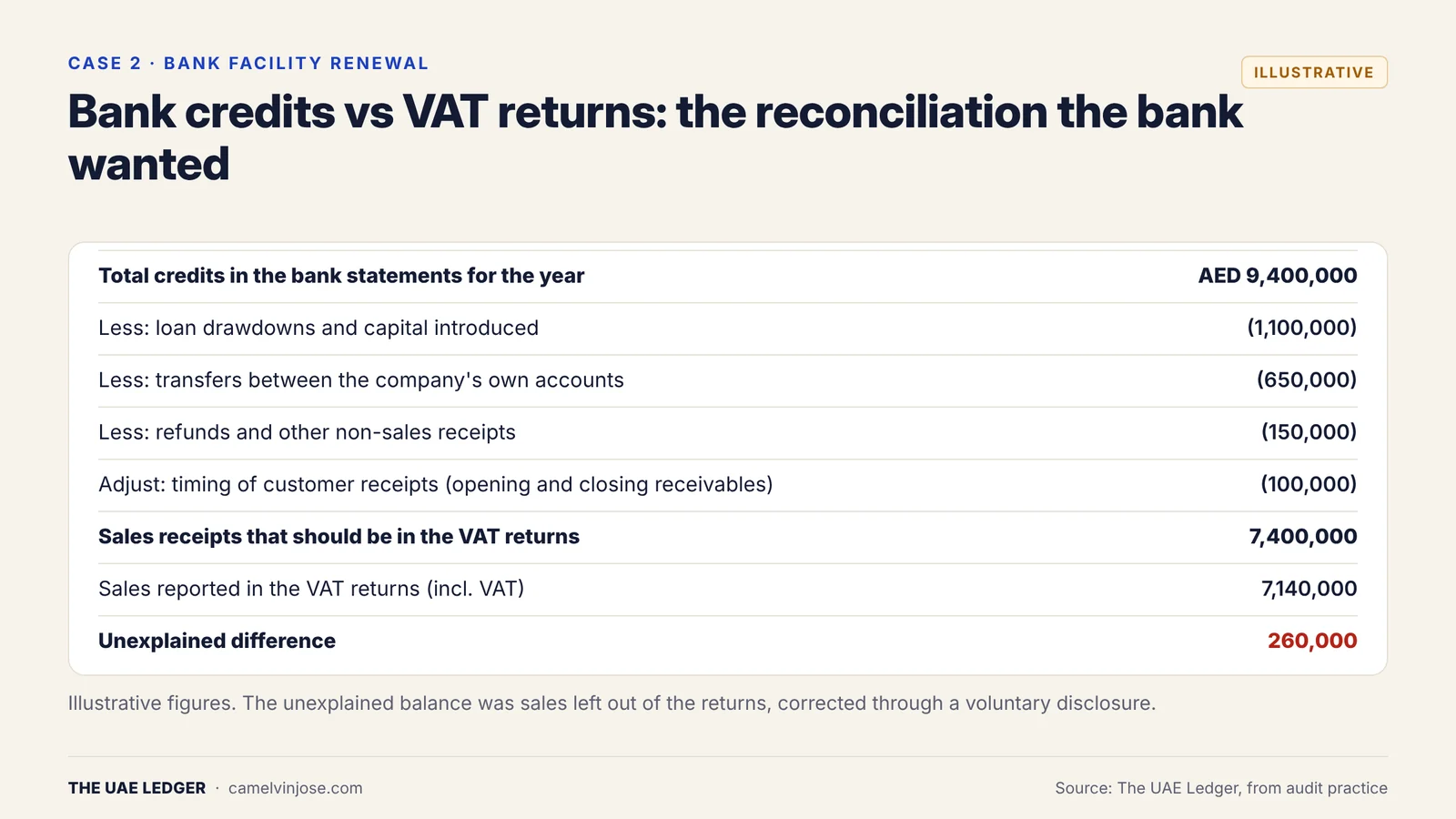
With illustrative figures:
| AED | |
|---|---|
| Total credits in the bank statements | 9,400,000 |
| Less: loans drawn and capital introduced | (1,100,000) |
| Less: transfers between the company’s own accounts | (650,000) |
| Less: refunds and other non-sales receipts | (150,000) |
| Adjust: timing of customer receipts | (100,000) |
| Sales receipts that should be in the returns | 7,400,000 |
| Sales in the VAT returns, including VAT | 7,140,000 |
| Unexplained | 260,000 |
Compare like with like. Bank receipts include VAT, so compare them with sales including VAT. And include zero-rated and exempt sales, which are reported in their own boxes of the return.
The usual reconciling items
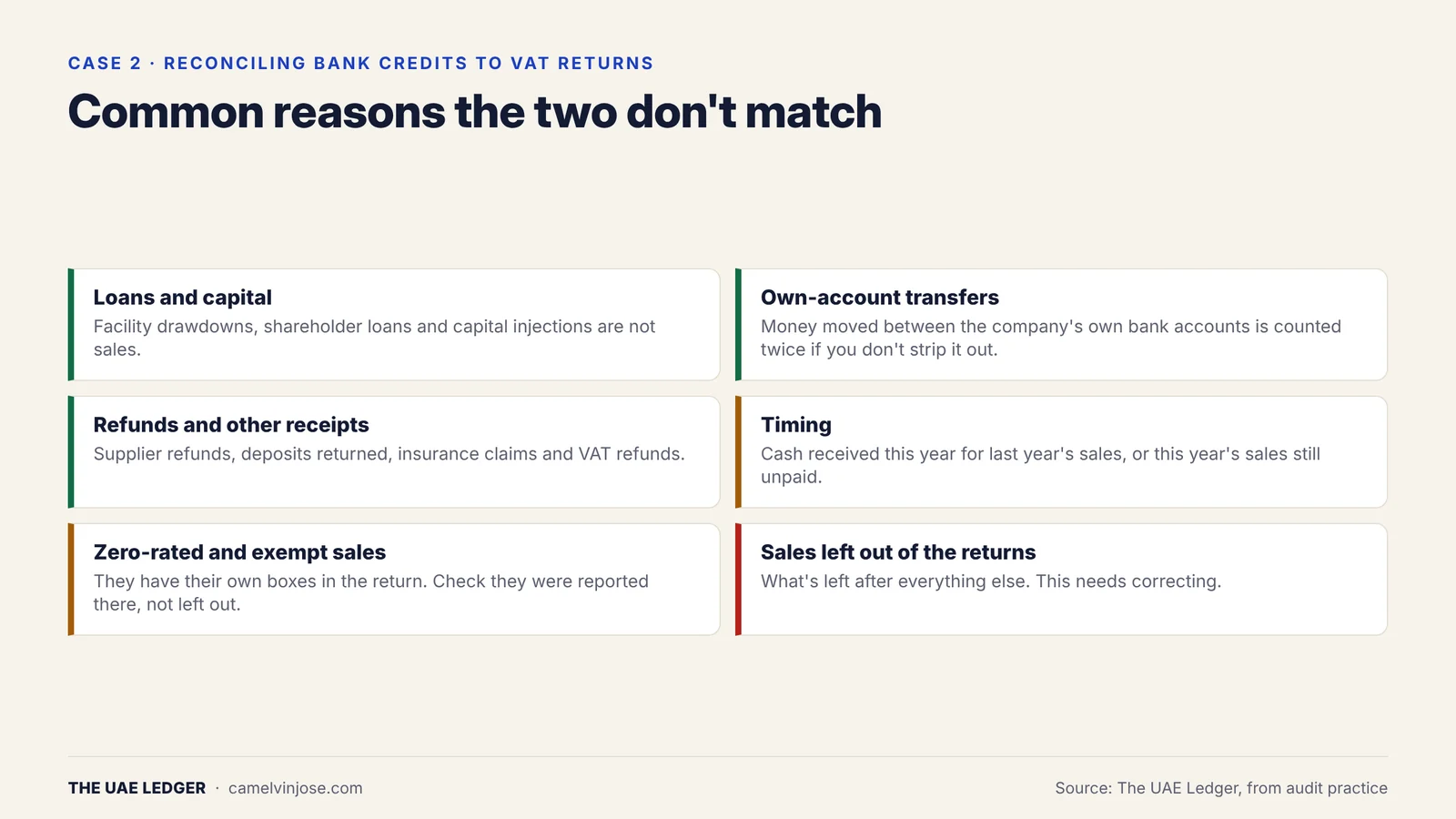
- Loans and capital: facility drawdowns, shareholder loans and capital injections.
- Own-account transfers: money moved between the company’s own bank accounts appears as a credit in one of them.
- Refunds and other receipts: supplier refunds, returned deposits, insurance claims and VAT refunds.
- Timing: cash received this year for last year’s sales, and this year’s sales still unpaid at year end.
- Zero-rated and exempt sales: these belong in their own boxes of the return. Check they were reported there and not left out.
- Sales left out of the returns: whatever remains after all of the above. That needs correcting.
Keep a document for every line. “Loan from shareholder” with nothing behind it won’t satisfy a bank, an auditor or the FTA.
When the gap is unreported sales
Unreported sales mean the VAT returns were wrong, so this stops being only a bank matter. The Tax Procedures rules decide how to correct it:
- Over AED 10,000 of tax: file a voluntary disclosure within 20 business days of becoming aware of the error.
- AED 10,000 or less: you can correct it in the return for the period in which you found it.
A voluntary disclosure carries penalties, but they’re lower than if the FTA finds the error in an audit. The Penalty Estimator compares the two for your figures.
Run the check before anyone asks
- Reconcile bank credits to sales every quarter, before you file the VAT return. As a routine it takes an afternoon. In the middle of a facility renewal, it takes weeks.
- Tag non-sales receipts as they come in: loans, capital, transfers and refunds. Year-end reconciliation becomes a report instead of a project.
- Keep a short note and a document for every reconciling item.
- Fix errors promptly, through the next return or a voluntary disclosure, depending on the amount.
Your auditor runs the same test at year end: see what your auditor actually tests in your VAT returns.
The other case in this pair: the FTA query that followed a customer’s tax evasion.
Facing the same question from your bank? Ask me about it.
Common questions
Why would my bank compare VAT returns with bank credits?
To check that the sales in your VAT returns are consistent with the money coming into your account before it renews or extends a facility.
What explains a gap between bank credits and VAT sales?
Loans and capital, transfers between your own accounts, refunds and other non-sales receipts, timing, and zero-rated or exempt sales. Whatever is left may be unreported sales.
How do I correct unreported sales found in the reconciliation?
Over AED 10,000 of tax: file a voluntary disclosure within 20 business days of becoming aware. AED 10,000 or less: correct it in the return for the period you found it.
This article is general information and may be out of date. Check the latest guidance from the Federal Tax Authority before acting.