The 95% Test: Can Your Companies Form a UAE Tax Group?
The nine conditions to form a UAE Corporate Tax Group, and the 95% ownership traps in the FTA's examples: legal title, nominal value, chains, preferred shares.
Part 1 covered what a Tax Group gets you. This part covers who qualifies. Most groups that fail don’t fail on the obvious conditions. They fail on how “95%” is measured.
The nine conditions
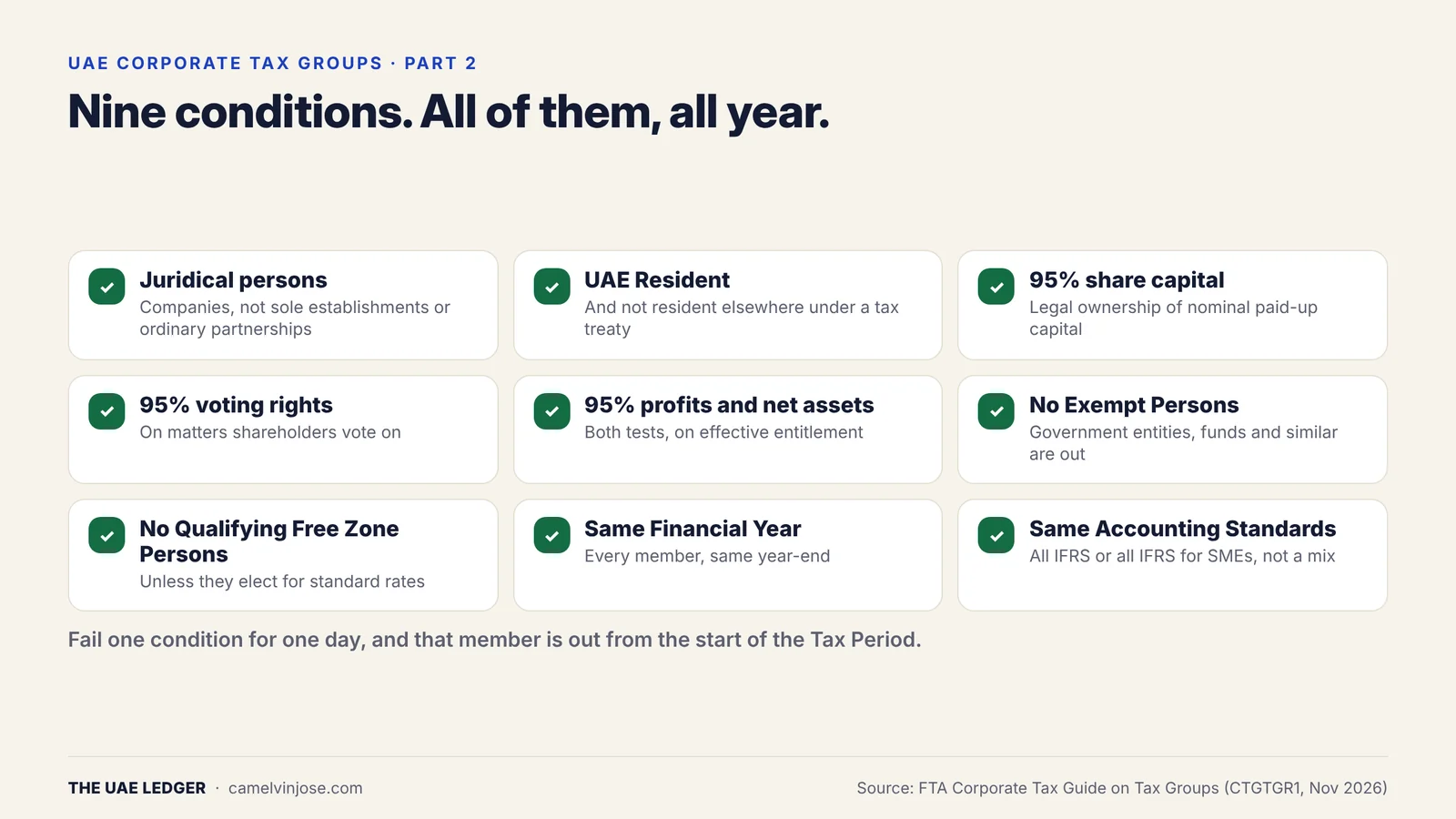
Under Article 40(1) of the Corporate Tax Law, the Parent Company and every Subsidiary must be:
- Juridical persons. Companies qualify. A sole establishment run by an individual doesn’t. An ordinary unincorporated partnership doesn’t either, unless the FTA has approved it as a Taxable Person in its own right.
- UAE Resident Persons, and not treated as tax resident in another country under a tax treaty the UAE has in force.
- 95% share capital. The Parent owns at least 95%, directly or through Subsidiaries.
- 95% voting rights.
- 95% of profits and net assets. Both tests must be met.
- Not Exempt Persons. That rules out Government Entities themselves, though their taxable subsidiaries can group in certain cases.
- Not Qualifying Free Zone Persons. A free zone company that isn’t a QFZP can join, and so can a QFZP that has elected to pay the standard rates.
- On the same Financial Year.
- Using the same Accounting Standards. All IFRS, or all IFRS for SMEs, but not a mix.
And the rule that catches people out: every condition must be met continuously for the whole Tax Period. Miss one for a single day and that company is out of the group from the start of the year (Part 3).
Trap 1: indirect ownership only counts through Subsidiaries
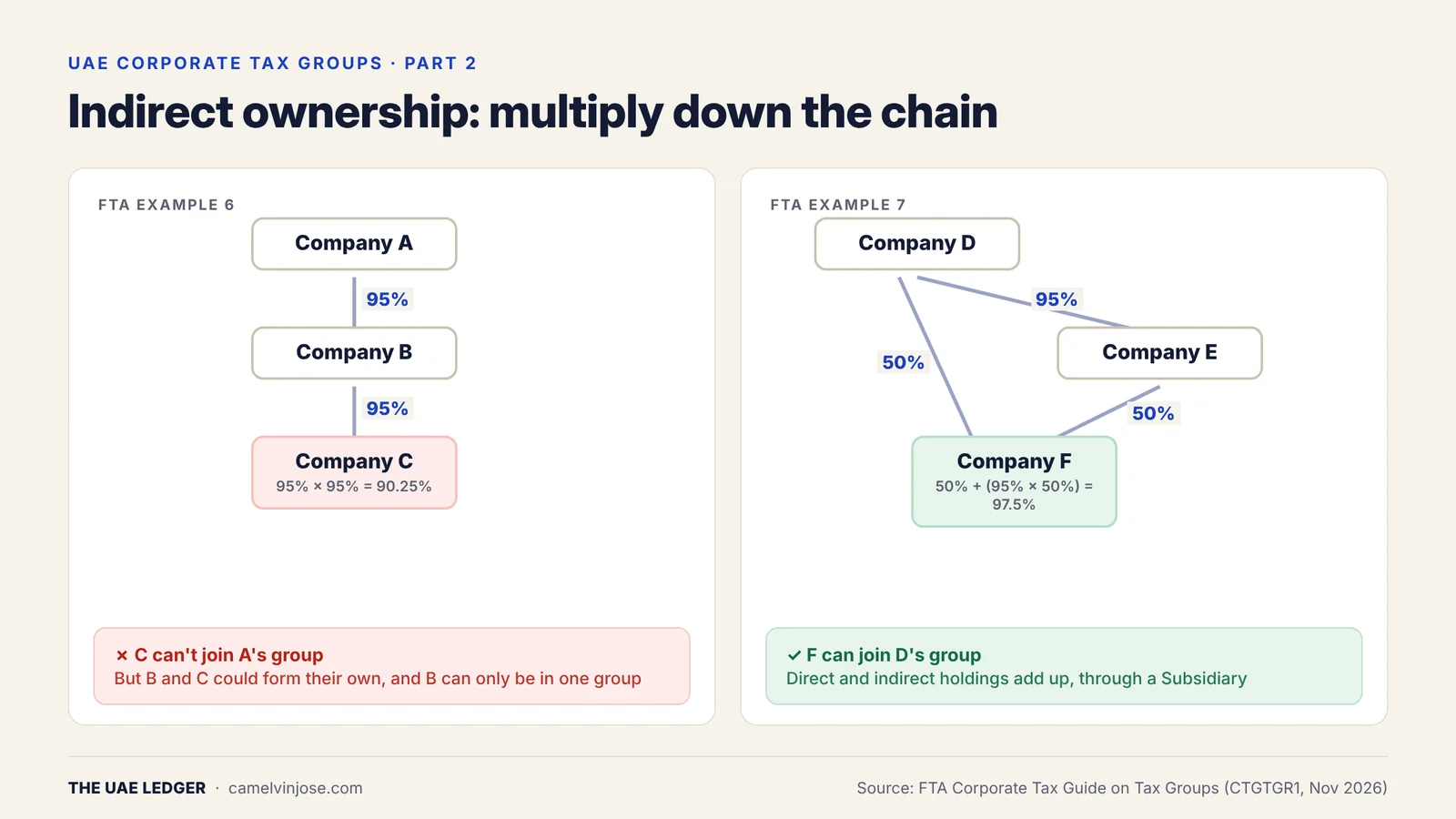
Indirect holdings count, but only through companies that are themselves in the group. Percentages multiply down the chain:
- Example 6: A owns 95% of B, and B owns 95% of C. A’s indirect stake in C is 95% × 95% = 90.25%, so C can’t join A’s group. B and C could form their own group, but B can only be in one group at a time.
- Example 7: D owns 50% of F directly and 95% of E, and E owns the other 50% of F. D’s total stake in F is 50% + (95% × 50%) = 97.5%, so F can join.
It also means one non-qualifying company in the middle breaks the chain for everything below it. In Example 4, the middle company P is a Qualifying Free Zone Person. So N can group with neither P nor P’s 100% subsidiary Q.
Trap 2: a foreign parent can’t be in the group
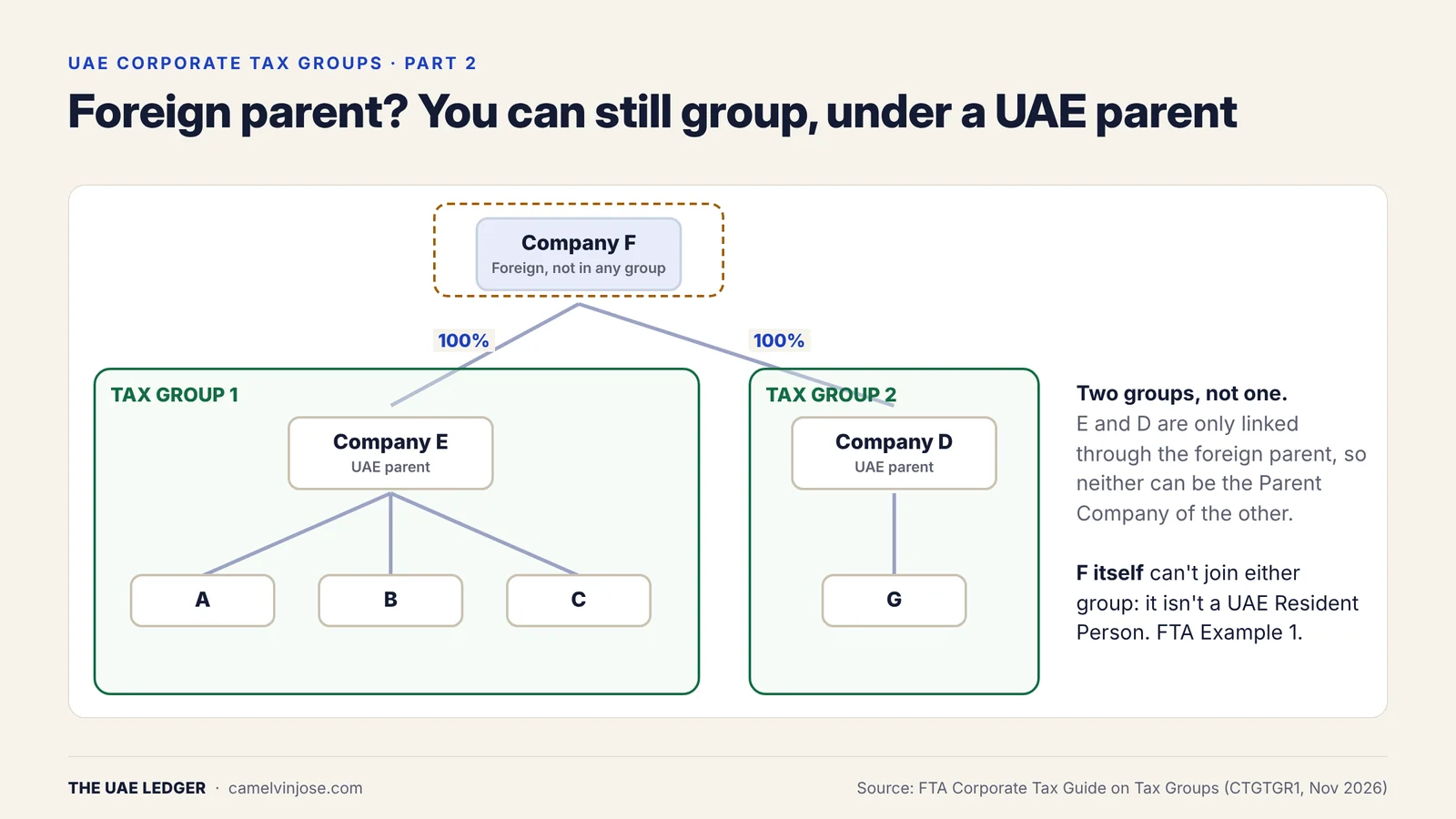
A foreign company that isn’t UAE resident can’t be a member. Its UAE subsidiaries can still group, but only under a UAE resident Parent Company.
In Example 1, foreign Company F owns two separate UAE holding companies, E and D. You end up with two Tax Groups (E with A, B and C; D with G), not one. E and D are linked only through the foreign parent, so neither can be the Parent of the other.
What to do about it: if you want one UAE group, you need one UAE holding company above all the UAE entities.
Trap 3: how “95%” is measured
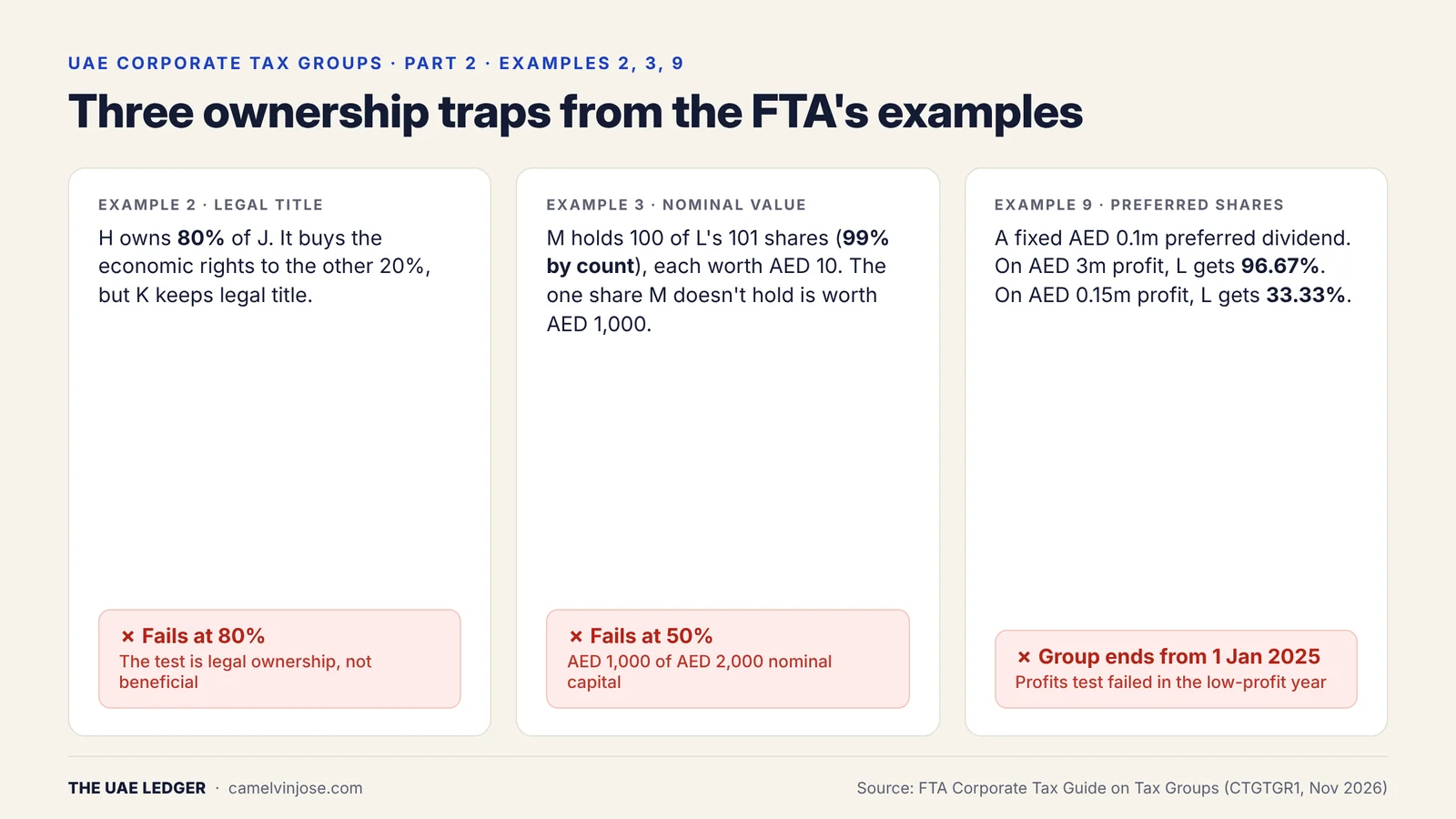
- Legal title, not economic ownership (Example 2). H owns 80% of J and buys the economic rights to the other 20%, but K keeps the legal title. The share capital test looks at legal ownership, so H fails at 80%. Nominee arrangements don’t count.
- Nominal value, not share count (Example 3). M holds 100 of L’s 101 shares, which is 99% by count. But M’s shares are worth AED 10 each and the one share M doesn’t hold is worth AED 1,000. By nominal value M owns 50%, and fails.
- Profit entitlement can drop below 95% (Example 9). A preferred shareholder takes a fixed AED 0.1m dividend. In a year with AED 3m profit, the ordinary shareholder gets 96.67% and passes. In a year with AED 0.15m profit, it gets 33.33%. The group then ends from the start of that year, and the FTA must be notified within 20 business days of the year end.
Also: convertible loans, warrants and options don’t count as share capital. On voting rights, non-voting shares are excluded, but a minority holder’s right to appoint a director doesn’t break the test by itself as long as the Parent keeps at least 95% of shareholder votes.
Fixing a Financial Year mismatch
If everything else lines up but the year-ends don’t, a company can apply to the FTA to change its Tax Period. The adjusted period can’t be shorter than 6 months or longer than 18 months. In Example 10, P (December year-end) buys Q (August year-end) in May 2024. They can align either way: P moves to August and they group from 1 September 2025, or Q moves to December and they group from 1 January 2025.
Before you apply: a quick check
- Draw the legal ownership chart and calculate each member’s percentage by nominal value, multiplying down every chain.
- Check every company in the chain is resident, isn’t a QFZP and isn’t exempt.
- Check shareholder agreements and any preferred shares for profit and liquidation rights, not just votes.
- Confirm one year-end and one accounting standard for everyone.
Next, Part 3: joining, leaving and closing a group, and why a 7-day share transfer can cost a company a whole year.
Common questions
How is indirect ownership counted for the 95% test?
Percentages multiply down the chain, and only through companies that are themselves in the group. If A owns 95% of B and B owns 95% of C, A's stake in C is 90.25%, so C can't join A's group.
Can a foreign parent company be in a UAE Tax Group?
No. A non-resident company can't be a member. Its UAE subsidiaries can only group under a UAE resident Parent Company.
Does the 95% test use the number of shares?
No. It uses legal ownership measured by nominal value. Holding 99% of shares by count can be only 50% by nominal value, which fails the test.
This article is general information and may be out of date. Check the latest guidance from the Federal Tax Authority before acting.