Joining, Leaving or Closing a UAE Tax Group: The Timing Rules That Catch Groups Out
When changes to a UAE Corporate Tax Group take effect, the 20-business-day notification rule, and why a 7-day share transfer can cost a company a whole year.
Groups change. Companies are bought, sold, merged and set up. Under the Tax Group rules, when a change takes effect is often more surprising than the change itself.
This is Part 3. Part 2 covered the conditions; this part covers what happens when they stop being met.
The core rule: whole periods, not days
A company has to meet every condition continuously throughout the Tax Period. There’s no apportionment. If it fails for part of a year, it’s treated as outside the group for the whole year.
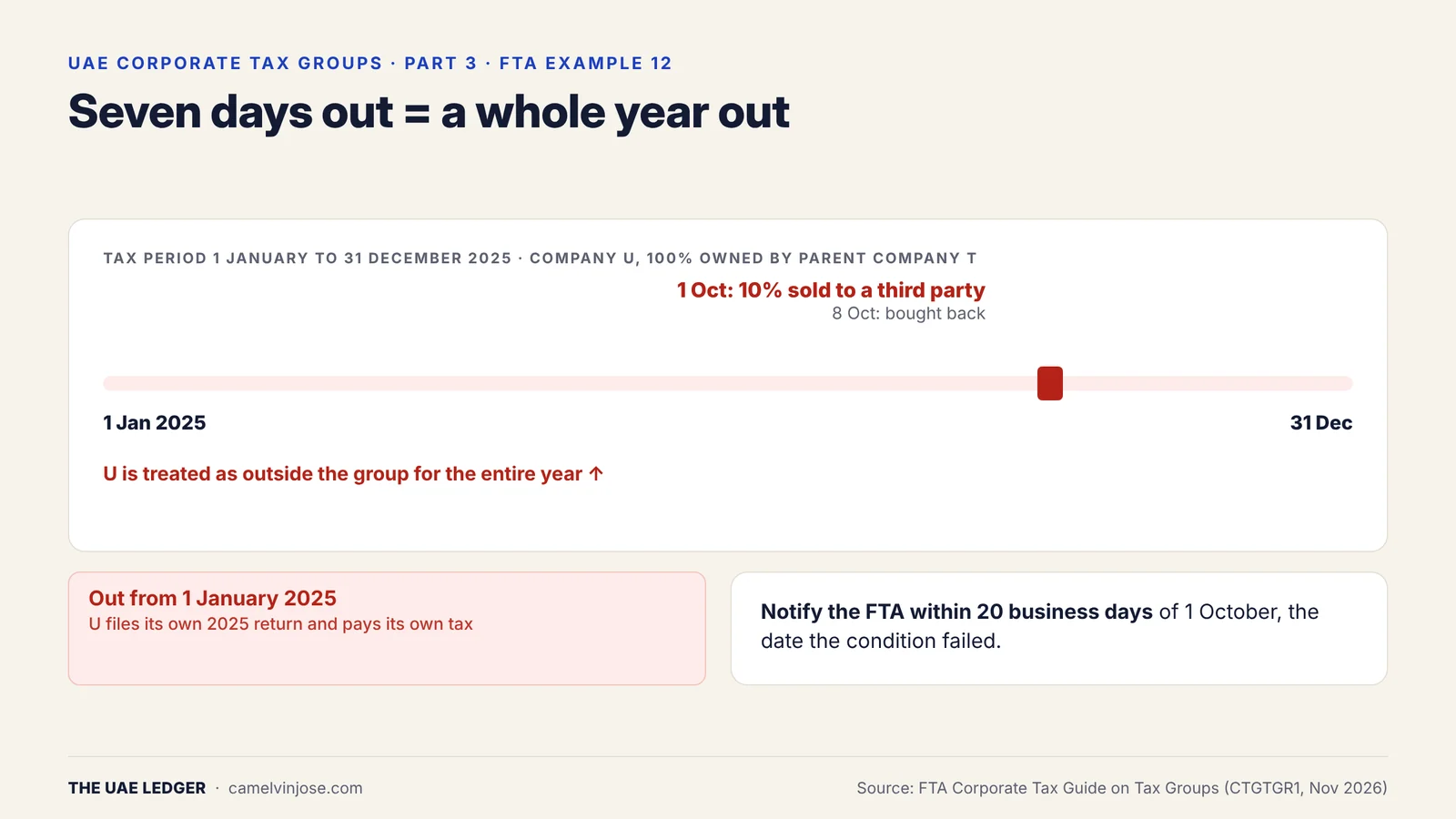
FTA Example 12. T (the Parent) owns 100% of U. On 1 October 2025, T transfers 10% of U to a third party, and on 8 October buys it back. For seven days, T’s stake was 90%.
The result:
- U is out of the group from 1 January 2025.
- U files its own 2025 Tax Return and pays its own tax.
- T has to notify the FTA within 20 business days of 1 October, the day the condition failed.
The lesson: run any share movement involving a group member past the tax team first. That includes “temporary” transfers, nominee changes and new share issues.
When each change takes effect
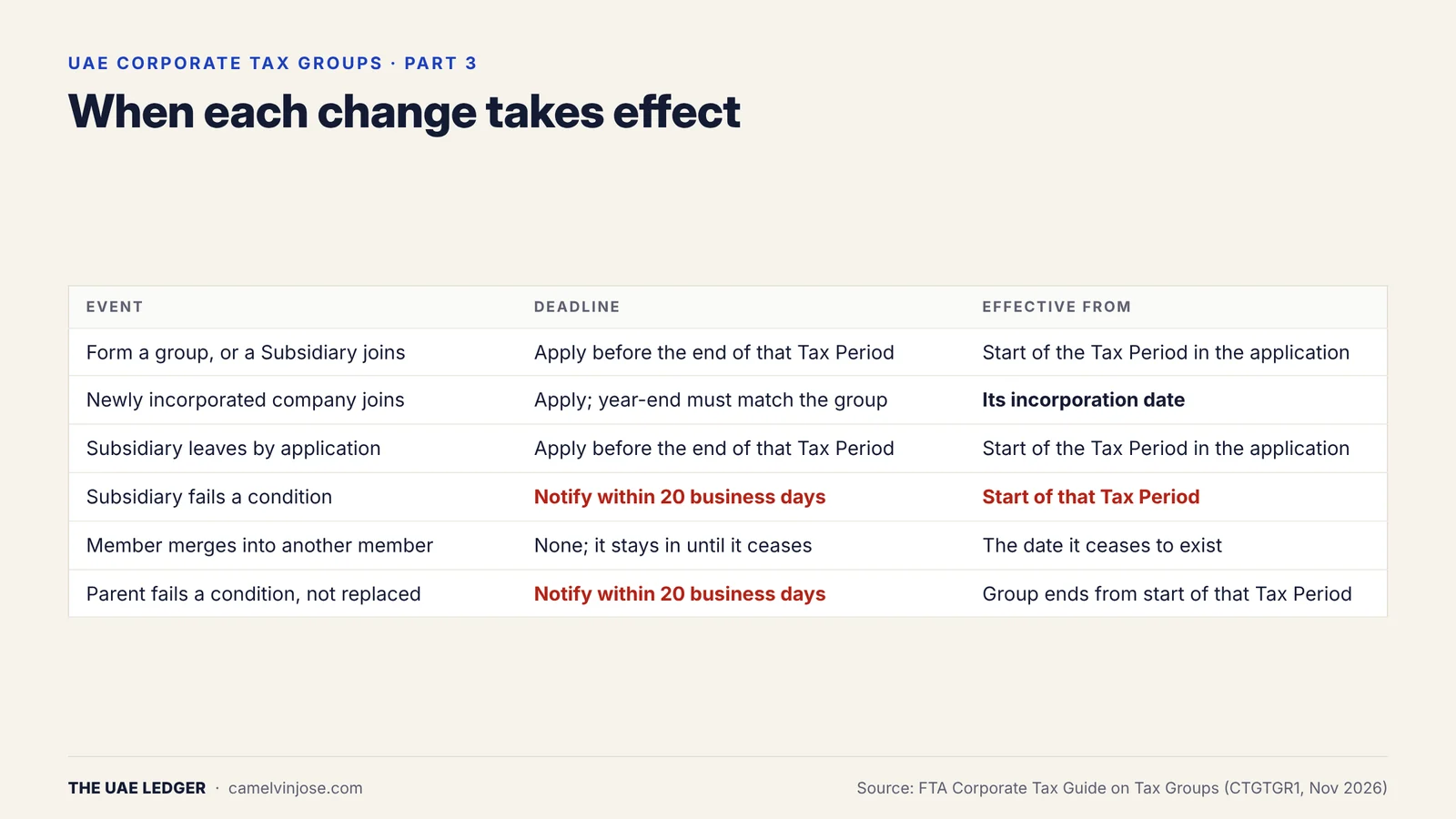
- Forming, joining, leaving or closing by application: apply through EmaraTax before the end of the Tax Period you want the change to apply to. It takes effect from the start of that period, or from another period the FTA decides on.
- A newly incorporated company can join from its incorporation date, as long as its first year-end matches the group’s. In Example 11, a subsidiary set up on 15 September 2024 joins from that date. It doesn’t have to wait until 1 January 2025.
- A member that fails a condition is out from the start of that Tax Period, and the FTA must be notified within 20 business days.
- A member that merges into another member stays in the group until the date it ceases to exist.
FTA approval also isn’t a permanent green light. If the conditions aren’t met throughout the group’s first period, the FTA treats the group, or that member, as never having been formed for that period, even though it approved the application.
Selling a subsidiary
When a member is sold to a buyer outside the group:
- it leaves from the start of the Tax Period in which the sale happens, and so do any subsidiaries below it,
- the buyer can’t group with it for that period either, because neither side owned it for the whole year.
On timing: for the share capital test, the seller remains the owner until legal title passes. Signing the share purchase agreement isn’t enough. For the profits and net assets test, the buyer is generally treated as entitled once the agreement becomes unconditional.
When the Parent Company changes
A group can carry on under a new Parent Company in two situations:
- the new Parent meets all the conditions in relation to the old Parent, for example a holding company above it that becomes eligible, or
- the old Parent ceases to exist and the new Parent, or a Subsidiary, is its universal legal successor (for example, after a merger).
You apply before the end of the relevant Tax Period, and you can do so while the merger is still being prepared.
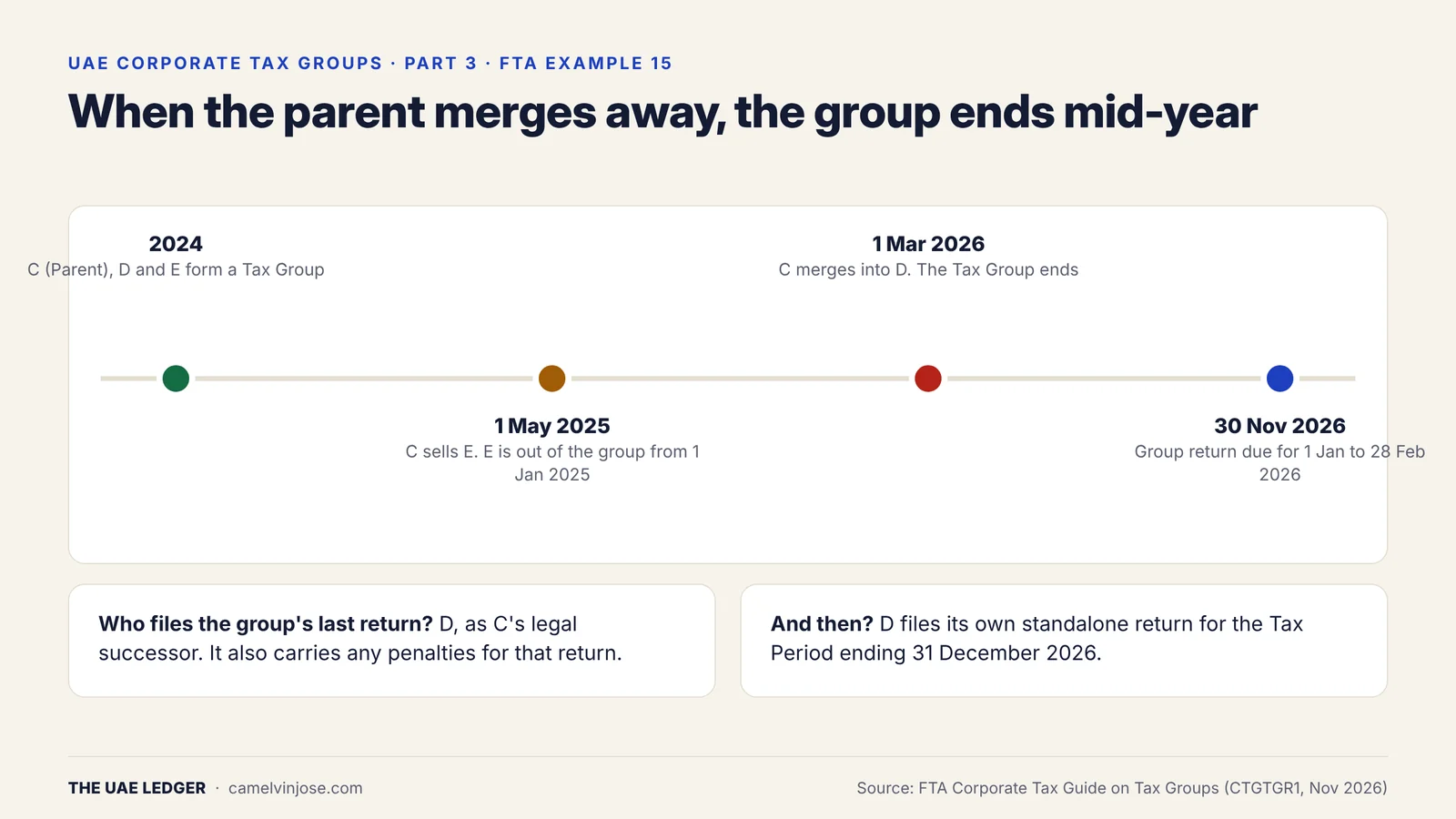
FTA Example 15 puts several rules together:
- C (the Parent), D and E form a group in 2024.
- C sells E on 1 May 2025, so E is out from 1 January 2025. C and D carry on as a group.
- On 1 March 2026, C merges into D. Only one member is left, so the group ends that day.
- D, as C’s successor, files the group’s final return for 1 January to 28 February 2026, due 30 November 2026. D is also liable for any penalties on that return.
- D then files its own standalone return for the year to 31 December 2026.
Two returns for one calendar year, from one surviving company.
After a company leaves
- It keeps its own TRN. It doesn’t deregister, and it files standalone returns from then on.
- It stays jointly liable for the group’s tax for the years it was a member, unless that liability was limited.
- If it ceases to exist (dissolved or liquidated, rather than merged into another member), it must apply to deregister within 3 months.
- A company or group that has left can rejoin or re-form in a later period by applying again.
Get it wrong and the cost compounds
If nobody spots that a member dropped out, the group’s return is wrong and has to be corrected. The Parent carries the penalties for that. The member that dropped out may also face penalties for not filing its own return. Keep a monthly check of who owns what for every group member.
Next, Part 4: how the group’s taxable income is built from Aggregated Financial Statements, and why your IFRS consolidation won’t do.
Common questions
What happens if a Tax Group member drops below 95% for a few days?
It is treated as outside the group for the whole Tax Period. In FTA Example 12, seven days at 90% took the subsidiary out from 1 January, so it had to file its own return for the year.
When does a sold subsidiary leave the Tax Group?
From the start of the Tax Period in which the sale happens, along with any subsidiaries below it. The buyer can't group with it for that period either.
Does a company deregister when it leaves a Tax Group?
No. It keeps its own TRN and files standalone returns. It stays jointly liable for the group's tax for the years it was a member.
This article is general information and may be out of date. Check the latest guidance from the Federal Tax Authority before acting.