E-Invoicing Goes Live on 1 January: A Six-Week Readiness Plan for AED 50m+ Businesses
A week-by-week plan for UAE businesses with AED 50 million+ revenue to be ready for mandatory e-invoicing on 1 January 2027: scope, data, testing, controls and cut-over.
If your business had revenue of AED 50 million or more in its latest financial statements, e-invoicing becomes mandatory on 1 January 2027. That’s six weeks from now, with National Day and the year-end close in between.
This is a week-by-week plan to get there. Every rule in it comes from the Ministry of Finance’s E-Invoicing Guidelines v2.1, Ministerial Decision No. 197 of 2026 and Cabinet Decision No. 173 of 2026. Each one has a full guide on this site, linked below.
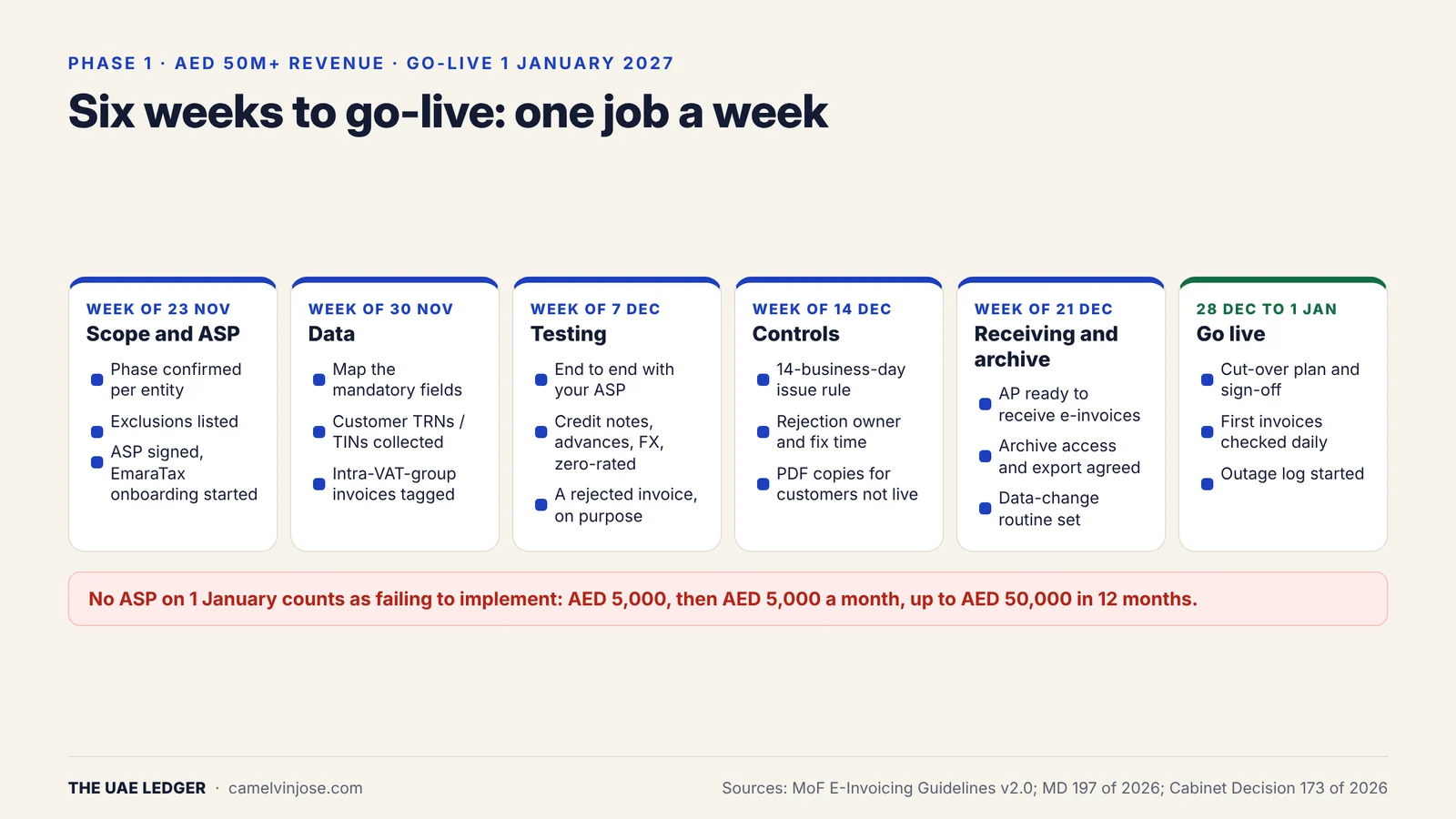
Week of 23 November: scope and ASP
- Confirm the phase for each entity, on revenue in its latest financial statements. The guidelines don’t say whether revenue is added up across a group, so test each entity on its own figures. (Who must comply)
- List what’s excluded: sales to consumers, imports, exempt and zero-rated financial services, and transactions inside the same VAT Tax Group until 31 December 2028. A Corporate Tax Group doesn’t count. (MD 197 explained)
- Check the ASP is signed and that onboarding has started from the e-invoicing tile in EmaraTax. The deadline to appoint was 30 October 2026. If you haven’t, this is the only job this week. (Choosing an ASP)
- Get a TIN for any in-scope entity without a TRN, and note each entity’s Peppol ID: 0235 followed by its 10-digit TIN.
Week of 30 November: data
- Map your invoices against the mandatory fields. There are 51 under PINT-AE, plus conditional ones. The usual gaps are buyer legal registration details and electronic addresses. (The five-corner model)
- Clean the customer master: collect each customer’s TRN (or TIN if not VAT-registered). Never put a Corporate Tax TRN in the VAT number field.
- Tag intra-VAT-group invoices in the ERP so they can be excluded now and brought in on 1 January 2029.
Week of 7 December: testing
- Test end to end with your ASP: sending, receiving and FTA reporting, with real scenarios.
- Include the awkward invoices: a credit note covering several invoices, an advance and its final invoice, a foreign-currency invoice and a zero-rated sale.
- Send one that fails on purpose, so you see how a rejection comes back and who receives it.
Week of 14 December: controls
- The 14-business-day rule. E-invoices and credit notes must be issued and transmitted within 14 business days of the transaction. VAT timing rules still apply alongside it, so build both into the billing cut-off.
- Rejections. Name who monitors failed invoices and how quickly they’re fixed. The 14-day clock doesn’t stop while an invoice sits in an error queue.
- Customers who aren’t live yet. You still issue the e-invoice through your ASP, to the placeholder endpoint 0235:9900000098, and also send a normal tax invoice, such as a PDF, so they can recover input VAT.
Week of 21 December: receiving and archive
- Get accounts payable ready to receive. The penalty for failing to implement applies to recipients too, not only to issuers. (Penalties)
- Agree archive terms. You must keep e-invoice data for the Tax Procedures Law period, generally 5 years. If the ASP or ERP host stores it, make sure the contract gives you access and export for that whole period.
- Set a data-change routine. Not telling your ASP about changes to your FTA-registered details costs AED 250 a day. Add it to the licence-renewal checklist.
28 December to 1 January: go live
- Sign off the cut-over plan: which invoices go out the old way before 1 January, and which go through the ASP from then on.
- Check the first invoices daily in the first week: delivered, accepted, reported.
- Start an outage log. There’s no longer a duty to report system failures, but an outage doesn’t stop the 14-day clock.
If you’re not going to make it
Say so early, and keep going. The penalty for failing to implement is AED 5,000 for the first instance, then AED 5,000 for each month or part of a month it continues, capped at AED 50,000 in any 12 months. Every month you’re live sooner saves money. The per-invoice penalty, AED 100 an invoice capped at AED 5,000 a month, matters less than the commercial cost: customers’ payables teams may not process invoices that don’t come through the system.
Not Phase 1?
Businesses under AED 50 million appoint an ASP by 31 March 2027 and go live by 1 July 2027. The same six steps apply, with more time. The Deadline Planner puts both dates in your calendar.
Sources: UAE Electronic Invoicing Guidelines v2.1 (Ministry of Finance, 25 November 2026); Ministerial Decision No. 197 of 2026; Cabinet Decision No. 173 of 2026; Ministerial Decision No. 244 of 2025 as amended.
Common questions
When does UAE e-invoicing start for large businesses?
Businesses with revenue of AED 50 million or more in their latest financial statements must go live by 1 January 2027. The deadline to appoint an ASP was 30 October 2026.
What happens if my business isn't live on 1 January 2027?
Not implementing e-invoicing, including not appointing an ASP, is penalised at AED 5,000 for the first instance and AED 5,000 for each month it continues, capped at AED 50,000 in any 12 months.
Can I still send PDF invoices after go-live?
The legal invoice is the e-invoice sent through your ASP. A PDF can go alongside it, and to customers who aren't live yet you must also send a normal tax invoice so they can recover input VAT.
How long do I have to issue an e-invoice?
E-invoices and e-credit notes must be issued and transmitted within 14 business days of the transaction, subject to the VAT Law's own timing rules.
This article is general information and may be out of date. Check the latest guidance from the Federal Tax Authority before acting.