Who Are You Actually Buying From? The Supplier Checks the FTA Now Expects
The supplier checks under FTA Decision No. 13 of 2026: identity, place of business and three red flags, explained through FTA Examples 1, 2 and 3.
In Part 1 we saw that your input VAT is now only as clean as your supplier. So the obvious next question: how well do you actually know your suppliers?
For many SMEs, the honest answer is “a phone number and a TRN.” Article 3 of Decision No. 13 asks for three things more.
Check 1: Who are they?
What you need depends on whether the supplier is an individual or a company.
Individual supplier (natural person)
- A copy of a valid ID: Emirates ID or passport.
- Meet them before any VAT-able supply: in person, by phone or by video call.
Company supplier (legal person)
- Verify incorporation using official databases (for example, the ADGM or DIFC registries), or the certificate of incorporation or trade licence.
- The details must be valid and match the name, address and employees.
- A valid ID for the director, agent or authorised employee you deal with.
The common SME gap is freelancers and small contractors sourced online, with no ID on file. A two-minute video call and an ID copy closes it.
Check 2: Do they actually exist somewhere?
This applies to individuals and companies alike. Confirm there is a real place of business, using map and navigation platforms or a site visit. It must also fit the activity: a machinery supplier should have a yard or warehouse, not a desk in a shared office.
FTA Examples 1 and 2: same question, opposite outcomes
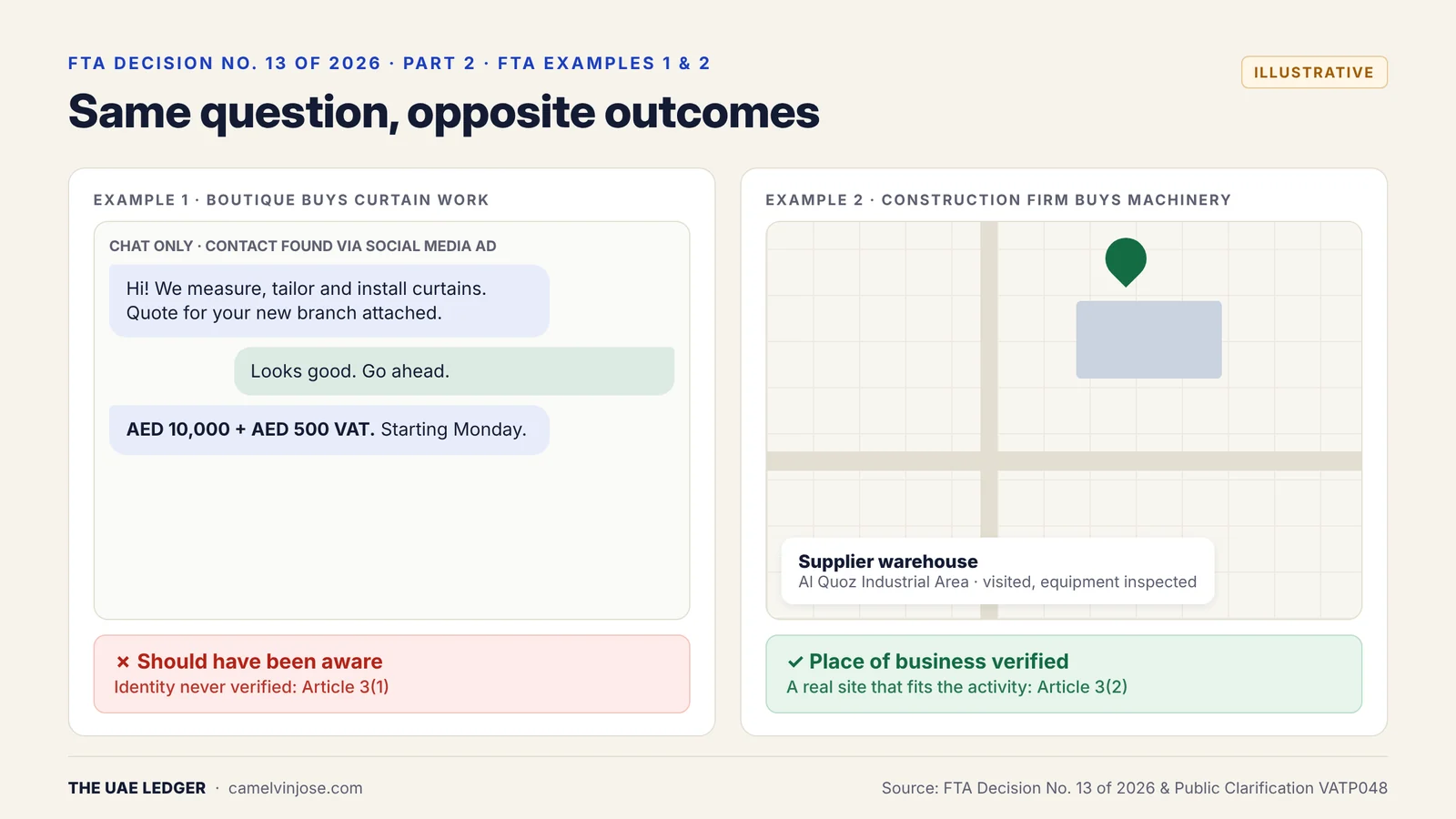
Example 1: the boutique. A boutique opening a new branch finds a curtain specialist through social media ads. All communication happens on WhatsApp. The supplier’s identity is never verified. The job is billed at AED 10,000 + AED 500 VAT for measuring, tailoring and installing.
Result: if evasion is established, the boutique should have been aware. Identity was never verified under Article 3(1). Note that the job was not below AED 10,000, so the small-supply exception (Part 3) didn’t help.
Example 2: the construction firm. A construction company needs light machinery and contacts a newly registered industrial supplier. Its representatives visit the supplier’s warehouse in Al Quoz Industrial Area and evaluate the equipment before completing the purchase.
Result: the place of business check is met under Article 3(2). A real warehouse that fits a machinery business.
The difference isn’t the size of the business or the deal. It’s that one buyer looked and the other didn’t.
Check 3: Any red flags?
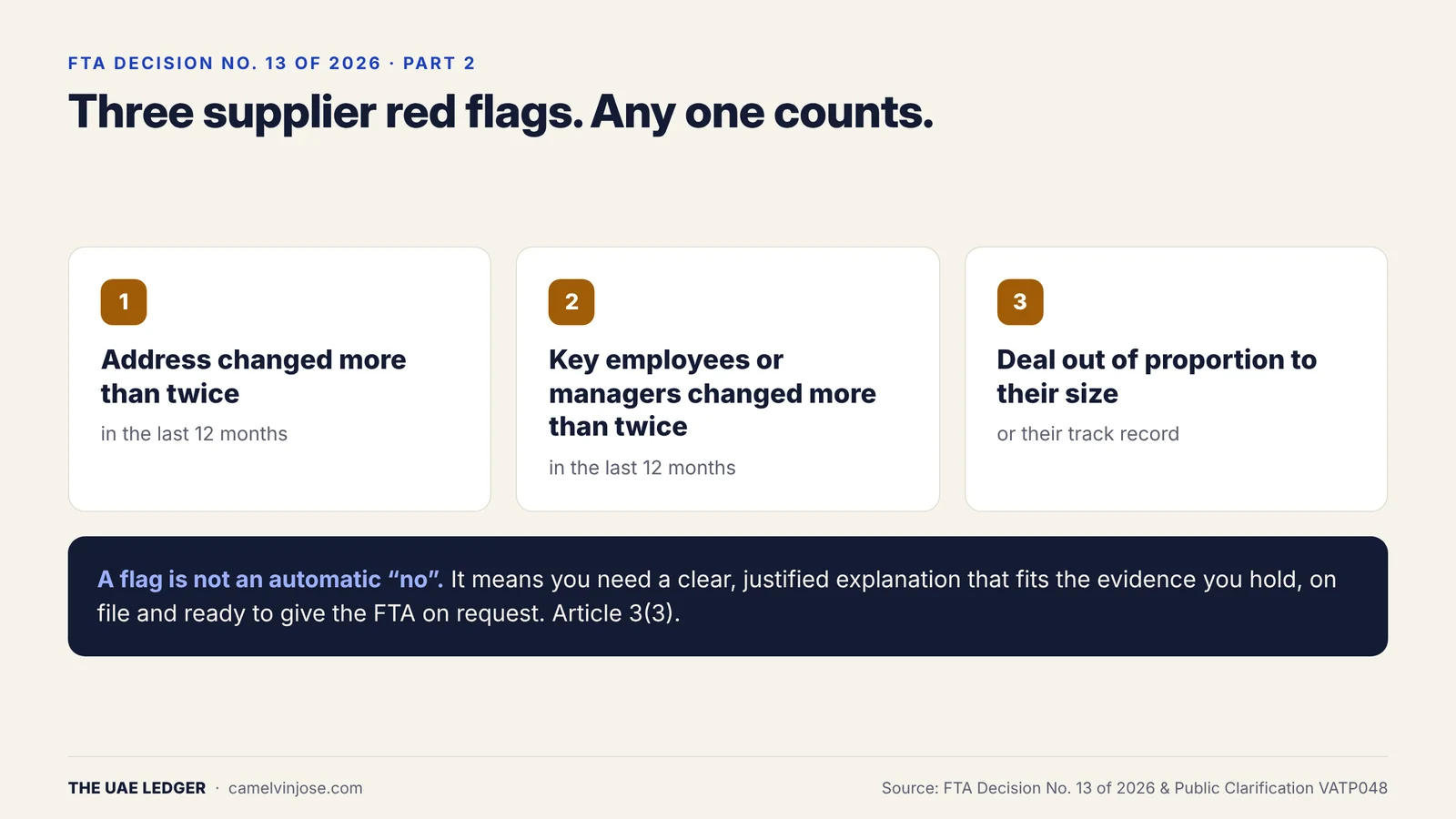
Decision No. 13 lists three risk indicators. Any one of them counts as a flag:
- The supplier’s address changed more than twice in the last 12 months.
- Key employees or managers changed more than twice in the last 12 months.
- The deal is disproportionate to the supplier’s size or track record.
A flag is not an automatic disqualification. It means you need a clear, justified explanation that is consistent with the evidence you hold, kept on file and ready to give the FTA on request.
FTA Example 3: the flag that was ignored
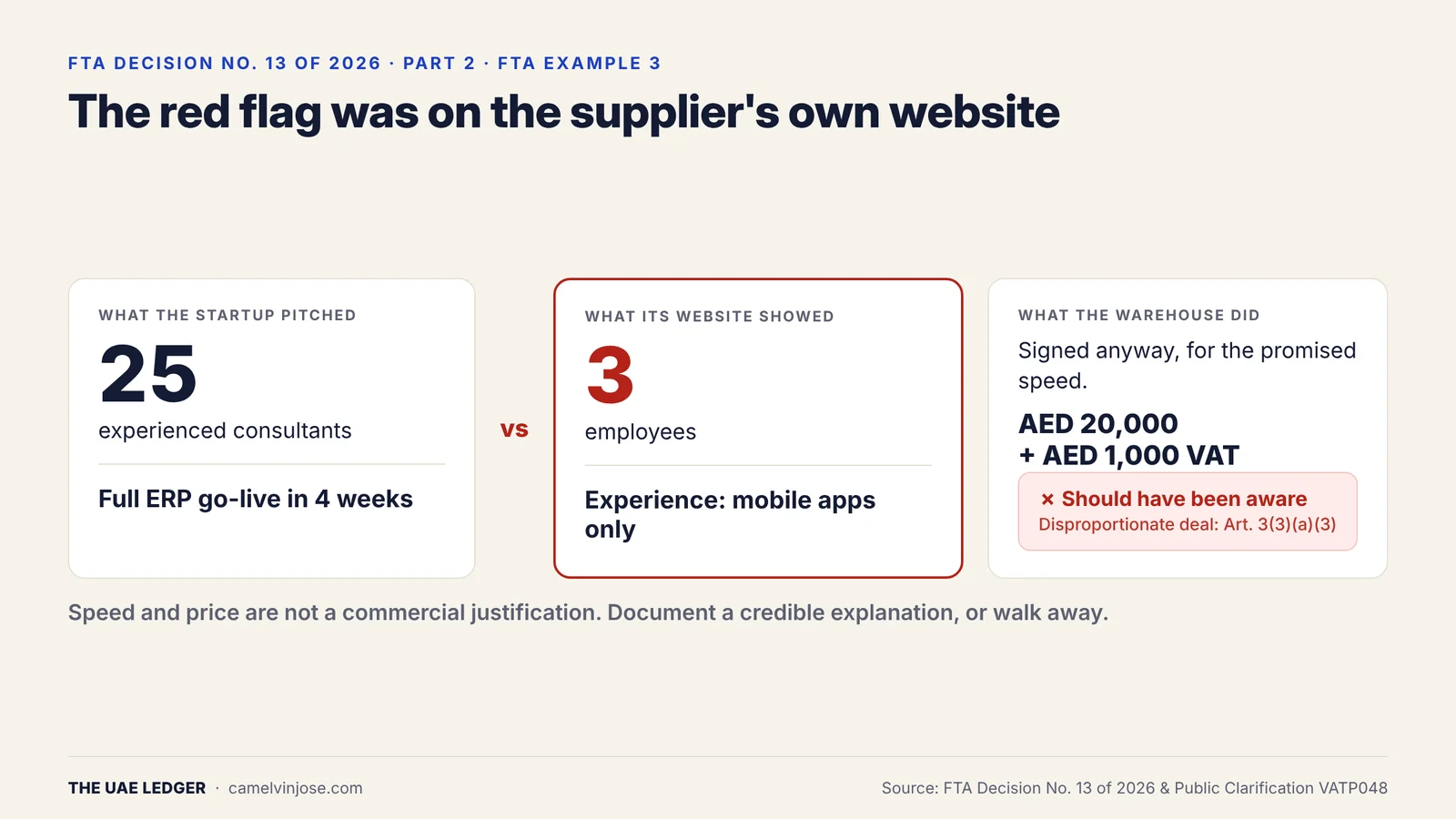
A large warehouse needs a new ERP system for real-time inventory and delivery insight. A startup software firm says it has a team of 25 experienced consultants and can go live in 4 weeks.
The startup’s own website shows 3 employees, with experience only in mobile apps.
The warehouse signs anyway, because of the promised speed: AED 20,000 + AED 1,000 VAT.
Result: if evasion is established, the warehouse should have been aware. The disproportionate-transaction indicator under Article 3(3)(a)(3) was visible from public information.
Three lessons:
- The mismatch was on the supplier’s own website. That is exactly the kind of check the FTA expects you to do.
- Speed or price is not a commercial justification.
- Finding a flag is fine. Proceeding without a documented explanation is the problem. Either write down a credible reason, or walk away.
Your supplier checklist (copy this)
For every new supplier, before the first VAT-able supply:
- ID copy (individual) or registry extract / trade licence + authorised person’s ID (company)
- Name, address and people match across documents
- Place of business confirmed by map capture or visit note, and it fits the activity
- Address changes in last 12 months: ___ (flag if more than 2)
- Key staff changes in last 12 months: ___ (flag if more than 2)
- Deal size vs supplier size and track record: proportionate? If not, explanation attached
Next, Part 3: how much of this you need depends on how much you spend. AED 10,000, 100,000 and 375,000 are the three numbers that set the depth of your checks.
Common questions
What supplier checks does FTA Decision No. 13 require?
Identity, a real place of business that fits the activity, and three risk indicators. Over AED 375,000 of spend you also need a bank account letter and a reputation review.
Is a red flag an automatic reason to stop buying from a supplier?
No. A flag needs a clear, documented explanation consistent with your evidence. Proceeding without one is the problem.
Is checking the supplier's TRN enough?
No. The FTA expects identity, place of business and risk checks as well, all documented before the first VAT-able supply.
This article is general information and may be out of date. Check the latest guidance from the Federal Tax Authority before acting.