Losses, Interest and Reliefs in a UAE Tax Group: What's Shared and What's Ring-Fenced
How UAE Tax Groups handle pre-Grouping losses, restricted losses, the interest limit, Small Business Relief and loss transfers, with FTA Examples 22, 36 and 39.
Pooling profits and losses is the main reason most groups form a Tax Group (Part 1). But not every loss pools. Losses brought in from before the group, and a group’s existing losses when a new member joins, are ring-fenced. Handle them wrong and they’re forfeited.
This is the final part of the series.
What’s shared and what’s ring-fenced
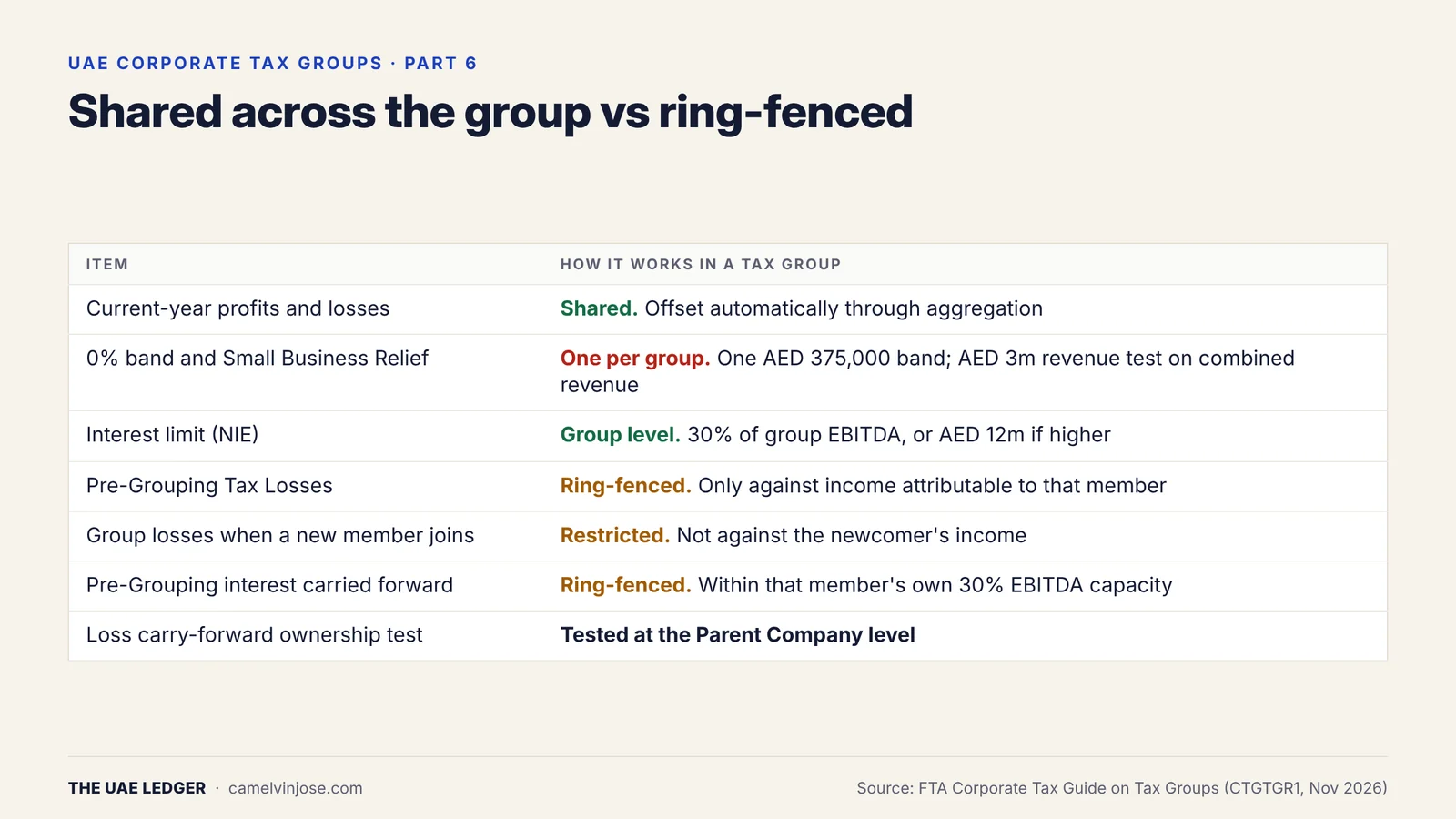
Applied to the group as a whole:
- Current-year results. One member’s loss offsets another’s profit automatically.
- The 0% band. The group gets one AED 375,000 band, however many members it has.
- Small Business Relief. Available only if the group’s combined revenue is AED 3 million or less in the current and every previous Tax Period, and no member belongs to a large multinational group that has to file Country-by-Country Reports.
- The interest limit. If net interest expense goes over AED 12 million, the deduction is capped at the higher of 30% of the group’s EBITDA or AED 12 million. One highly geared member can shelter behind the others’ EBITDA. The flip side is that a member with enough EBITDA on its own can still be restricted if the group as a whole doesn’t have enough.
- Participation Exemption thresholds. The 5% holding and AED 4 million cost tests are met by combining holdings across members, and across their Qualifying Group.
Ring-fenced:
- Pre-Grouping Tax Losses, meaning a member’s losses from before it joined.
- Restricted losses: the group’s own losses when a new member joins.
- Pre-Grouping interest carried forward.
Using a member’s pre-Grouping loss
To use a member’s old losses, the group has to work out the Taxable Income attributable to that member, as if it were filing alone. The loss can only be set against that income, and the usual 75% cap applies to the group’s Taxable Income.
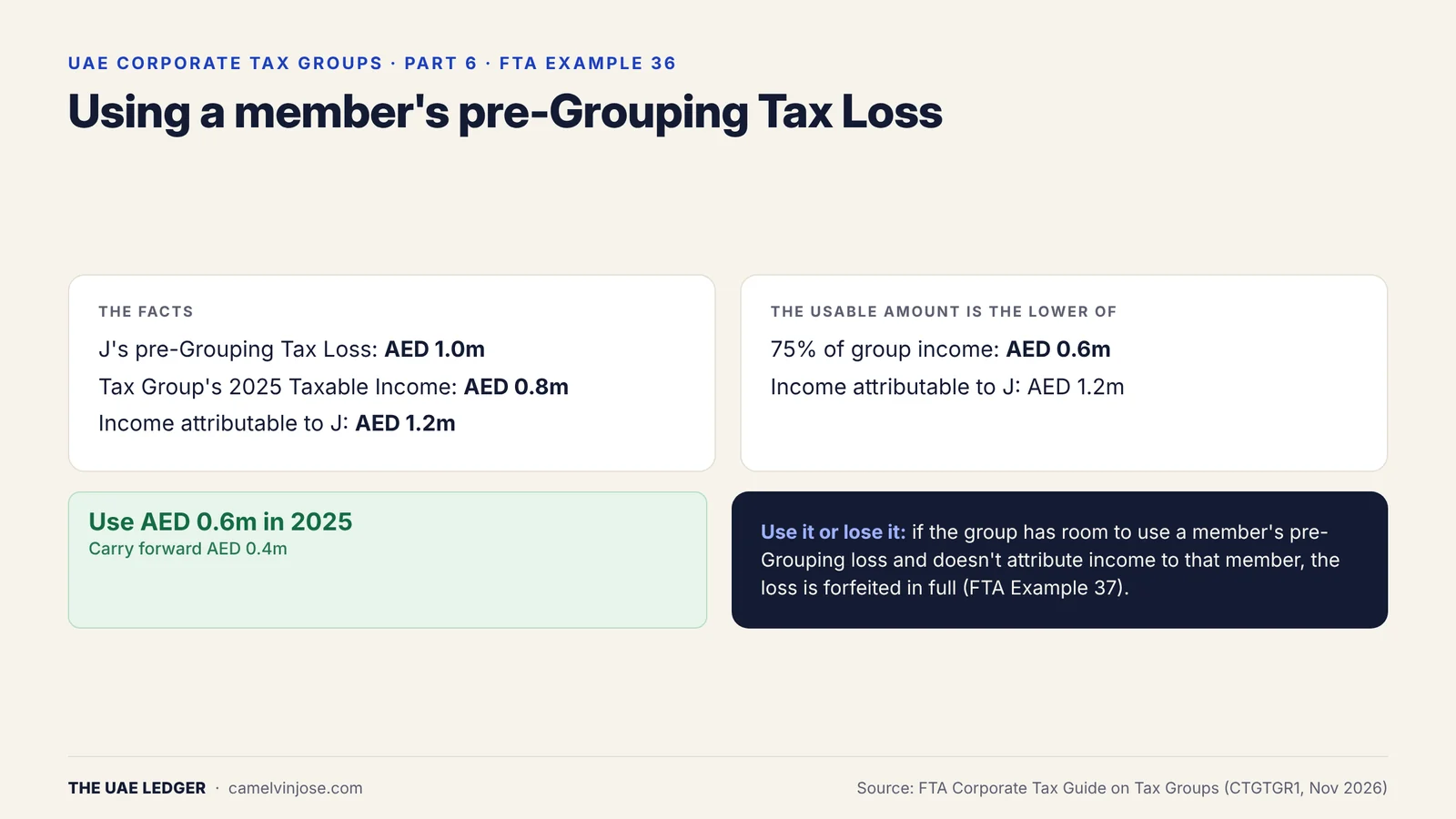
In FTA Example 36:
- J brings a pre-Grouping loss of AED 1m.
- The group’s 2025 Taxable Income is AED 0.8m, and the income attributable to J is AED 1.2m.
- The usable amount is the lower of 75% × 0.8m = AED 0.6m and J’s AED 1.2m.
- So the group uses AED 0.6m and carries AED 0.4m forward.
Pre-Grouping losses are used before the group’s own losses, and transferred-in losses come last.
Use it or lose it. If the group has room to use a member’s pre-Grouping loss but doesn’t attribute income to that member, the whole pre-Grouping loss is forfeited (Example 37). The same applies to pre-Grouping interest.
When a new member joins a group that has losses
The group’s existing losses become restricted. They can’t be used against income that belongs to the newcomer.
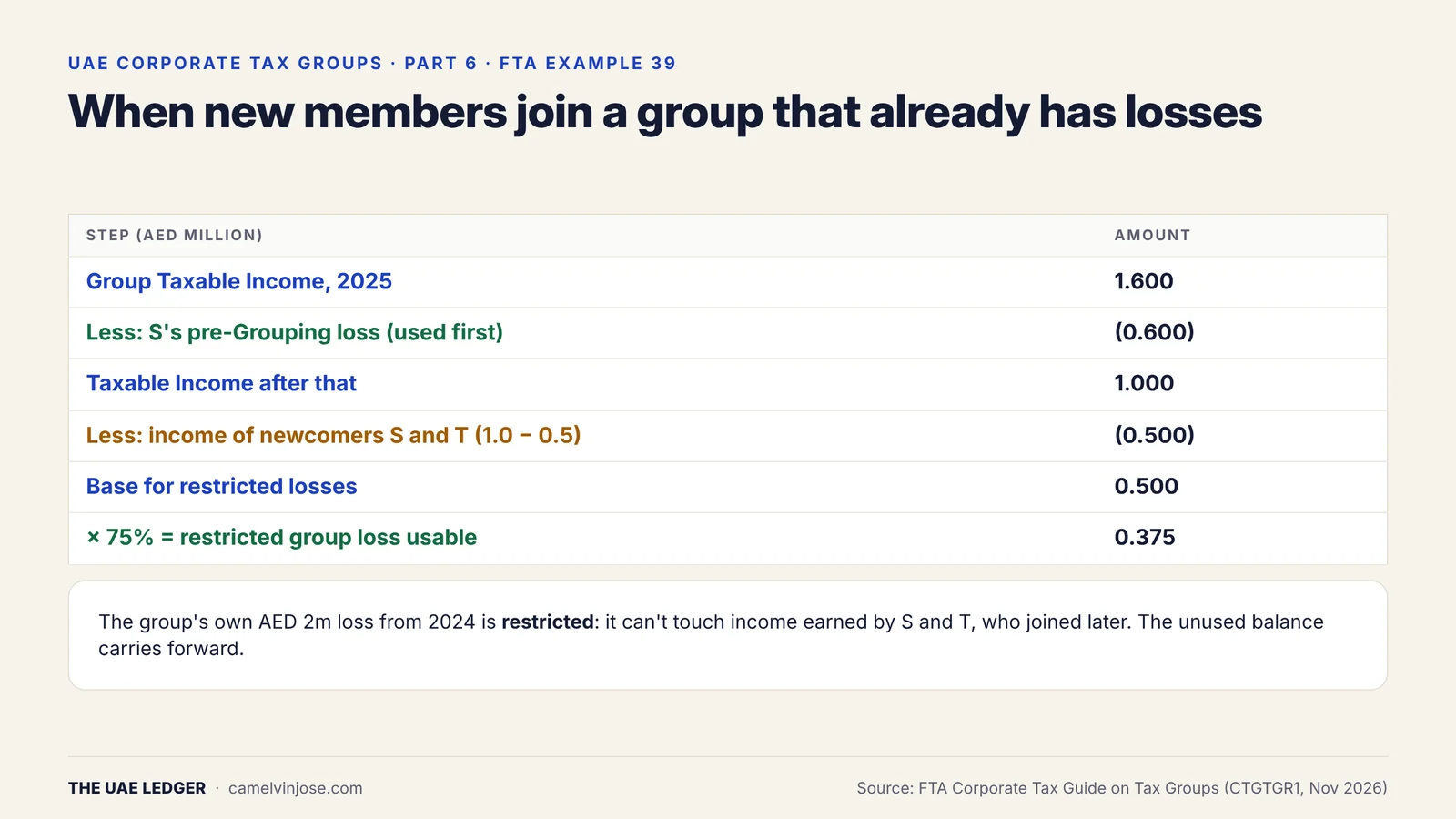
In FTA Example 39:
- The group has a 2024 loss of AED 2m. S and T join on 1 January 2025, and S brings its own AED 0.6m pre-Grouping loss.
- 2025 group income is AED 1.6m. S’s AED 0.6m is used first, which leaves AED 1.0m.
- The income attributable to the newcomers is S’s AED 1.0m less T’s AED 0.5m loss, so AED 0.5m.
- The restricted group loss can be used against at most 75% × (AED 1.0m − AED 0.5m) = AED 0.375m in 2025. The unused balance carries forward.
The 50% ownership test is applied at the Parent
Losses carry forward only if the same owners keep at least 50% of the business, or the same or a similar business continues. For a Tax Group, the test is applied to who owns the Parent Company. In Example 24, one shareholder holds 54% of the members through direct stakes (49% of the Parent plus 5% of the Subsidiary), but the other 51% of the Parent’s shares change hands. That’s a change of more than 50% at the Parent, so the ownership test fails. The business continuity test then has to be met instead.
On the other hand, members joining or leaving doesn’t by itself fail the ownership test.
Transferring a loss between two Tax Groups
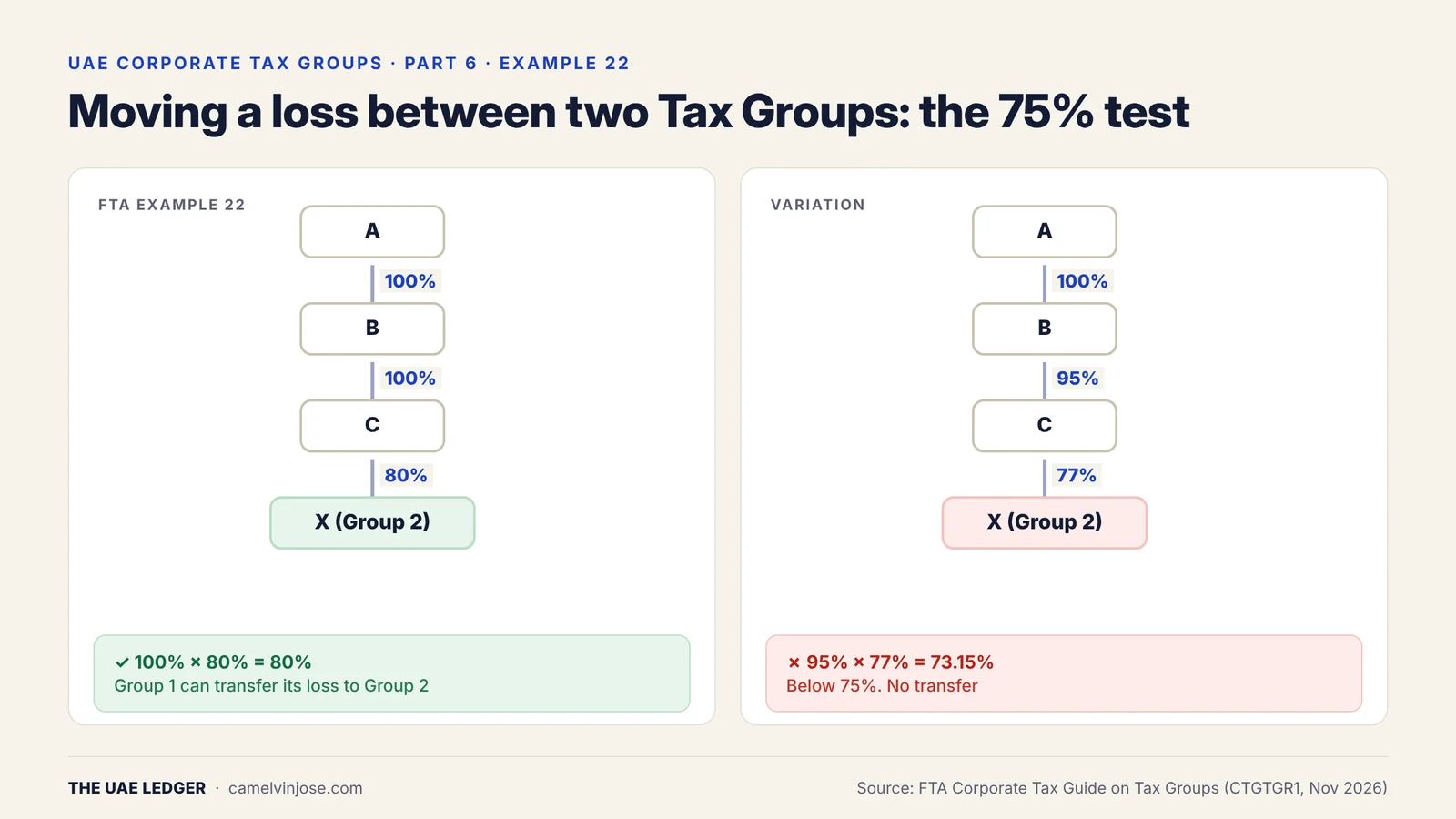
A Tax Group can transfer losses to another Taxable Person, including another Tax Group, if there’s 75% common ownership. That’s measured from one group’s Parent through to the other group’s Parent:
- Example 22: A owns 100% of B, B owns 100% of C, and C owns 80% of X, the Parent of Group 2. 100% × 80% = 80%, so the loss can be transferred.
- Variation: B owns 95% of C, and C owns 77% of X. 95% × 77% = 73.15%, so no transfer.
The ownership has to hold from the start of the year the loss arose to the end of the year it’s used. In Example 23, replacing Group 1’s Parent partway through the year breaks that.
What to do with your losses
- List every loss before grouping, by member and year, with the ownership history behind each.
- Prepare attribution workings every year for any member with pre-Grouping losses or pre-Grouping interest. If you skip them, those losses can be forfeited.
- Model the 0% band and Small Business Relief. A group of small companies can end up paying more tax than the same companies filing separately.
- Check common ownership before any deal that involves transferring losses between groups.
That’s the series: what a Tax Group is, who qualifies, timing, the numbers, the clawback and losses.
Common questions
Can a Tax Group use a new member's losses from before it joined?
Only against Taxable Income attributable to that member, worked out as if it filed alone, and subject to the 75% cap on the group's Taxable Income.
Can pre-Grouping losses be forfeited?
Yes. If the group has room to use a member's pre-Grouping loss but doesn't attribute income to that member, the whole loss is forfeited (FTA Example 37).
Can a Tax Group get Small Business Relief?
Only if the group's combined revenue is AED 3 million or less in the current and every previous Tax Period, and no member belongs to a multinational group that files Country-by-Country Reports.
This article is general information and may be out of date. Check the latest guidance from the Federal Tax Authority before acting.